The New Modern Mediterranean Diet and The Food Pyramid 2025
Inspired by Italian centenarians and the latest science, the New Modern Mediterranean Diet is a fresh, sustainable approach to healthy eating. This evolution of the classic Mediterranean diet honors cultural diversity and geographical uniqueness, making it globally relevant. It is represented by a new food pyramid that visually guides how often and how much to eat from each food group to support balanced nutrition and long-term healthy eating habits.
The New Modern Mediterranean Diet promotes balanced eating patterns centered on plant-based foods while including diverse sources of protein, healthy fats, and traditional Mediterranean foods in appropriate proportions. The 2025 updated Mediterranean Diet Food Pyramid combines the latest scientific research with the 2014 and 2018 Italian Nutrient and Energy Guidelines (LARN) and the 2018 Italian Dietary Guidelines, featuring 13 directives for a healthy diet.
The food pyramid considers unique foods, geography, and cultural contexts, making it adaptable worldwide. The MedDiet 4.0 framework further extends its global impact, benefiting individuals, communities, and future generations while preserving the cultural heritage of UNESCO-recognized Mediterranean Diet countries—Cyprus, Croatia, Spain, Greece, Italy, Morocco, and Portugal.
Numerous studies have associated higher adherence to Mediterranean dietary patterns with improved cardiovascular, metabolic, and overall health markers. Through this website, I aim to introduce this lifestyle to non-Mediterranean populations as a nutritional approach associated with supporting health and reducing risk factors linked to chronic diseases. Using The New Modern Mediterranean Diet Food Pyramid, I develop restaurant-quality international dishes that are easy to prepare at home, using DIY applications or with professional chef assistance.
The Dual-Track System: The Metabolic Switch
Did you know the Mediterranean Diet shares its core elements with the Healthy 2020 Dietary Pattern for Americans? To provide maximum flexibility and align with the Dietary Guidelines for Americans (DGA), our program offers a unique "Dual-Track" nutritional system tailored to your goals:
Modern Mediterranean Path: Our standard longevity plan, emphasizing the foundational elements of the traditional diet, including whole grains and artisan bread.
New American 2025 (DGA) Upgrade ("The Metabolic Switch"): This high-protein, low-carb metabolic optimization is designed for muscle maintenance and avoiding the carb crash. It intentionally swaps out grains and bread for roasted chicken "Power-Ups" and healthy fats.
The Key Components: 2025 Pyramid Updates
The 2025 Mediterranean Diet Food Pyramid is a comprehensive guide to healthy eating, emphasizing a shift toward plant-based foods and sustainability. The pyramid is broken down into daily, weekly, and occasional tiers:
The Daily Foundation
Extra-Virgin Olive Oil (EVOO): As the primary source of dietary fats, high-quality extra-virgin olive oil is placed at the center of the daily foundation. Rich in monounsaturated fats, antioxidants, and polyphenols, it is used generously to support heart health and enhance flavor.
Vegetables and Fruits: A cornerstone of the diet, daily consumption is highly recommended with a focus on a variety of colorful, seasonal produce.
Cereals and Whole Grains: Whole grains such as bread, pasta, rice, and couscous are staples, providing essential carbohydrates and fiber to offer sustained energy and support digestive health.
Dairy Products, Nuts, and Seeds: These provide essential nutrients like calcium, protein, and healthy fats. Milk and yogurt are recommended daily, while nuts and seeds serve as nutrient-dense options for snacks.
Weekly Food Choices
Legumes: Beans, lentils, and chickpeas are vital sources of plant-based protein, high in fiber, and highly beneficial for heart health and the environment. They are recommended 3 to 4 times per week.
Seafood, Poultry, and Eggs: Protein-rich foods are consumed in moderation, emphasizing lean proteins. Oily fish (rich in omega-3 fatty acids) is recommended at least twice a week. Poultry (white meat) and eggs serve as excellent, high-quality protein sources.
Potatoes: Important update! Potatoes have shifted to the weekly food tier. They should be eaten as an occasional side dish and should not be consumed in the same meal as pasta or bread to prevent blood sugar spikes.
Cheeses: Fresh and hard cheeses are moved to this tier to be consumed in moderation as a main protein source rather than an extra side dish.
Occasional Indulgences & Moderation
Red and Processed Meats: To support a more sustainable and disease-preventative lifestyle, red meats (beef, pork) and processed meats (sausages, cold cuts) are placed at the very top of the pyramid, reserved strictly for occasional consumption.
The "Less is Better" Rule for Sugar, Salt, and Alcohol: The modern diet emphasizes limiting added sugars and "discretionary" salt. While wine is historically valued in the Mediterranean for enhancing the social aspects of dining, it is not a requirement for health. If consumed, it should be in strict moderation (typically no more than one glass per day for women and two for men) and never on an empty stomach.
Guidelines for Success
Daily Guidelines: The daily recommendations focus on hydration, whole grains, a generous intake of vegetables and fruits, moderate consumption of EVOO, and the inclusion of dairy, nuts, seeds, and legumes.
Weekly Guidelines: The weekly recommendations encourage dietary diversity by incorporating different protein sources like seafood, poultry, and eggs.
Customization and Adaptation: The New Modern Mediterranean Diet Pyramid is flexible. Whether following a vegetarian or omnivorous diet, the pyramid's principles can be adapted to fit your lifestyle.
Applied Through the MFL Program Framework™
The New Modern Mediterranean Diet provides the scientific foundation behind the MFL Program Framework™. Through this framework, Executive Chef Giuseppe Urbano translates established Mediterranean nutrition principles, dietary guidelines, and culinary practices into practical meals designed for everyday life.
Explore the foundations and practical application of this approach:
What Is the Mediterranean Diet? Discover the origins, principles, and lifestyle practices behind one of the world's most studied dietary patterns.
MFL Program Framework™: Explore how nutrition science, culinary medicine, and professional cooking techniques are combined into a practical system for sustainable healthy eating.
28-Day Mediterranean Diet Transformation Program: Apply these principles through a structured four-week journey with menus, recipes, and step-by-step guidance designed to help build healthier eating habits.
The Mediterranean Diet F.A.Q. Read some of the top questions that new customers often ask when considering a switch to the Mediterranean Diet.
What Are the Recommended Portions of Food Categories?
Tap on the bars below to view the recommended portion sizes for a Mediterranean Diet, based on a daily intake of 🅜 MEDIUM (2000 kcal) for a healthy adult between the ages of 18 and 65. The portions refer to food that has been cooked, with the skin, peel, trimmings, and water removed.
(Note: All protein weights in our specific meal plans are measured raw/pre-cooking for accuracy).
To help you achieve and maintain a healthy BMI, our Mediterranean Diet Meal Plan Builder offers adjustments for daily intakes of 🅢 SMALL (1500 kcal) and 🅛 LARGE (2500 kcal). For our clients on the Metabolic Switch upgrade, Small and Medium dinners include a 3 oz chicken Power-Up, while Large dinners feature a 6 oz Power-Up. If you are outside the specified age range, pregnant, nursing, or have a medical condition, please consult your doctor before making any dietary changes.
All portions are measured in grams (g), and liquids in milliliters (mL). Raw foods (vegetables, meats, grains) reflect trimmed, pre-cooking weights. Prepared items (breads, pastas, cold cuts, bakery goods) are measured as purchased. Additionally, please refer to your country’s dietary guidelines, such as the Dietary Guidelines for Americans (DGA) for recommended daily servings and portion sizes.
Food for every day
Food for every day: Include raw and cooked vegetable intake. Fruit juices are not considered a fruit substitute. Cereal and bread intakes should be at least 50% whole grain. Water consumption should be at least 1600 ml a day.
Food for every week
Food for every week: Legumes can be consumed in larger amounts for added protein and fiber; 50 g of dry products can be substituted for fresh ones. Seafood includes fresh, frozen, or canned fish and shellfish. Poultry includes rabbit, turkey, and chicken. (Ann Ig 2016; 28: 179-186 doi:10.7416/ai.2016.2096)
Portion sizes for occasional food
Portion sizes for occasional food: Alcoholic beverages are for adults only. The maximum indicated portion is 125 ml (1 glass) for wine, 330 ml for beer, 75 ml for vermouths, and 40 ml for spirits. Red meat includes beef, pork, and game.
The Meals for Longevity program is specifically designed based on the principles outlined in The New Modern Mediterranean Diet scientific publication.
Where Are the Sources of The New Modern Mediterranean Diet?
The Meals For Longevity program is guided by scientific research, as referenced in various dietary publications. Explore here below!
The Med Diet 4.0 framework
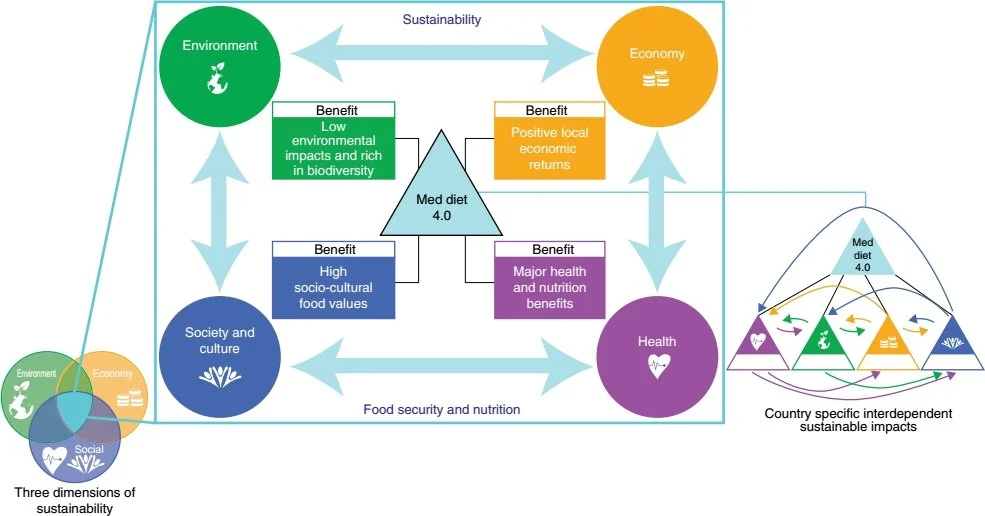
The Med Diet 4.0 framework represents a significant evolution in our understanding and promotion of the Mediterranean diet as a sustainable and holistic dietary model. This framework acknowledges the challenges faced by traditional dietary patterns and offers a multidimensional approach to revitalizing the diet.
Key Points About the Med Diet 4.0 Framework:
Shift Away from Traditional Patterns: Despite being recognized as one of the healthiest diets globally, adherence has declined in many Mediterranean countries. This negatively impacts health, social, economic, and environmental aspects of life.
Multidimensional Framework: It emphasizes the diet as a sustainable model, focusing on four interdependent benefits:
Nutrition and Health Advantages
Low Environmental Impacts and Biodiversity Richness
Positive Local Economic Returns
High Social and Cultural Food Values
Educational Focus: The framework advocates for personalized educational programs aimed at all age groups, incorporating values such as frugality, simplicity, authenticity, and tradition.
Role in Sustainable Food Systems: By reconnecting food consumption with production and emphasizing local, seasonal, and traditional practices, it aims to enhance the sustainability of global food systems.
Transform science-based nutrition principles into practical, enjoyable meals with the Meals For Longevity program.
Learn how the MedDiet 4.0 applies to you and to future generations.
Frequently Asked Questions About the New Modern Mediterranean Diet
-
The New Modern Mediterranean Diet is an updated interpretation of the Mediterranean dietary pattern that combines traditional Mediterranean food culture with modern nutrition science. It integrates the Mediterranean Diet Italian Food Pyramid, the Italian Dietary Guidelines, LARN nutritional references, and Mediterranean lifestyle principles to create a practical and sustainable approach to healthy eating.
-
The New Modern Mediterranean Diet builds on the traditional Mediterranean lifestyle while adapting it for today's global population. It recognizes cultural differences, geographic diversity, modern lifestyles, and updated nutrition research while maintaining the core principles of vegetables, fruits, legumes, whole grains, extra-virgin olive oil, seafood, balanced protein sources, and mindful eating.
-
The Mediterranean Diet Italian Food Pyramid is a visual guide that shows how often and how much different food groups should be consumed within a balanced Mediterranean dietary pattern. It organizes foods according to frequency, placing daily foods such as vegetables, fruits, whole grains, legumes, olive oil, and water at the foundation, while foods consumed less frequently appear toward the top.
-
Yes. One of the principles of the New Modern Mediterranean Diet is adaptability. The framework allows individuals and communities to apply Mediterranean dietary principles using locally available foods, cultural traditions, and personal preferences while maintaining the core concepts of dietary balance, sustainability, and healthy eating patterns.
-
The New Modern Mediterranean Diet provides the nutritional foundation behind the MFL Program Framework™. Meals For Longevity translates these scientific principles into practical recipes, weekly menus, meal planning tools, and chef-designed cooking experiences that help make Mediterranean eating easier to apply in everyday life.